COATS-OF-ARMS-HERALDRY.COM
All about heraldry
All about heraldry

Shopping basket
THE CREST
The
external ornaments of the coats of arms are : the crest, supporters,
the war cry, the motto, the mantle. Crest is all that surmounts the
escutcheon : helmets, wreaths, lambrequins, crests and coronets.
The helmet was employed by all the nations like defensive armour, and
the forms that one gave him changed according to times and the places.
Like guard of the head, it is the noblest piece of the armour of a
warrior, the shelter of the seat of the thought which contemplates the
tricks of war, the plans of battle, the great political combinations.
From there the habit came from placing it on the medium of the shield,
i.e. on the chief whom it seems to protect, and it was adorned the
distinctive marks most honourable, coronets indicating the titles.
Before the coronets were of a use as widespread as they are it today to stamp the coats of arms, one made use only of the helmet or helm, and by means of fixed rules, the position and the title of each gentleman were recognised perfectly. Though these payments were not always followed exactly, it should not be believed that the use of the various species of crests is optional. Before the fifteenth century, the helm was set of profile, on the left base of the shield, and it was not whereas a simple ornament; but when the fashion came from setting the shield of face, the helmet, preserved like ornament, was still the distinctive mark of the position of the people, and the following rules were laid down.
The helmet of the kings and the emperors Or, is damascened, tared (set) in face, the visor entirely opened and without grid, because the sovereign must all see and all to know. The helmet thus tared is the mark of the absolute power, which turns up only of God alone.
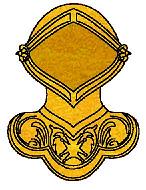
The sovereign princes and dukes bear the helmet also Or, damascened and tared of face, but less open than that of the sovereigns, to indicate that they turn up of a higher power. They can add eleven grids to it.
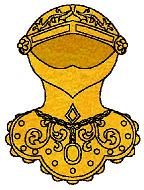
Nonsovereign dukes; the marquises, the large officers of the coronet, such as the chancellors, the admirals, the marshals, stamp of a helm Argent damaged of face, with eleven grids, damascened and fimbriated Or.
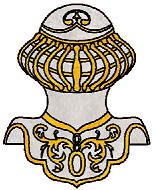
The helmet of the counts, viscounts and voided, is Argent, damaged to the third, with nine grids Or, the edges of the same. One sees it sometimes damaged of face, but it is an exemption from principles which could not be devoted, of the same by the use.
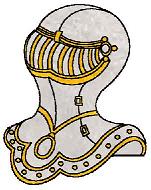
The helmet of the barons, is Argent set of three quarters, on seven grids Or only, and the board of the same.
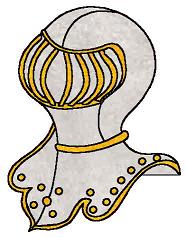
The old gentleman who was knight or whom the sovereign had dressed of some charges important in the armed ones or to the court, stamped his shield of a steel helmet polished, showing five grids Argent as well as the edges, and tared of profile.
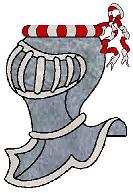
The gentleman of three paternal and maternal races bore his steel helmet polished, tared of profile, the opened visor, the nasal one turned up and the abased ventail, showing three grids with his visor.
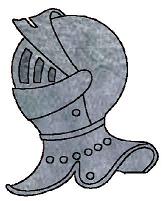
The new ennobled crest of a helmet of iron or steel polished, set of profile, whose nasal one and the ventail between is opened, which means that being the first of its race it does not have anything to see actions of others and must rather obey but to command.
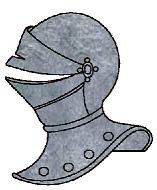
The helm of bastard is also of steel polished and damaged of profile, but turned in sinister, like mark of illegitimacy, and the completely lowered visor.
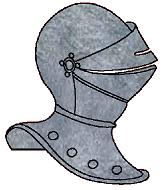
Some authors give to dukes eleven grids, new marquis, counts and viscounts seven, barons five, and gentlemen three.
The coronet was always embleme of sovereignty and command, and all the
people adorned the head of their chiefs of it. Homère extasy in front
of the coronets of the kings of which it paints the prowesses. Virgile
quotes Or the coronet of king Latinus, when it regulated the conditions
of the combat between Enée and Turnus. Diodore of Sicily called that
the helmet of Alexandre was adorned of a coronet Or, and the Aurélien
emperor, if Aurélius Victor is believed, bore a coronet Or raised of
stones of great price.
The first kings of France had as coronets only circles Or massive, set on the naked head or the helmet. It was Charlemagne which it first was covered with a genuine coronet adorned of fleurons and invaluable stones. Vulson called to have seen it preserved in the treasure of Saint-Denis and it gives of it a drawing which it ensures being exact fort, adding that this coronet was useful to the sacring of the kings.
All the noble ones titrated, in imitation of sovereigns, wanted to be vested of coronets, that they placed on the helms. The habit of always joining these two ornaments was abandoned and is to the practised nothing any more but in certain cases left besides imagination. One is satisfied almost generally today with surmounting the shield of a coronet.
On different occasions the sovereigns had to repress the usurpation of the coronets by people whom them title did not authorise to bear them. Thus counts took coronets of marquis or dukes, and of simple gentlemen wanted of the same to stamp their coats of arms of coronets belonging to higher titles. The stop of 1663 bearing tusk with any gentleman not titrated of taking the qualification of duke, marquis, count, etc…, under penalty of 1500 pounds of fine, put an end to the abuse during some time; but it was renewed soon, and one could believe today that there is no more of laid down rules, so much the usurpations of this kind were numerous. Let Us Hope that in the absence of legislative provisions, the public sarcastic remarks will make justice of these usurpations that one could not fade too much. (I often saw families taking a title in which they believed in good faith to have permissions, because they had a seal of family, crested of a coronet. One must look like a duty of lighting them in this respect, and of their making reject any claim based on an also futile and so contestable document).
The coronet of the popes or tiara is composed of a toque Or, adorned at its top of a surmounted sphere of a cross. It is accompanied of triple crowns Or, and lets hang two string semy of crosslets. The three coronets represent the pope like the sovereign sacrificator, the large judge, and the only legislator of the Christians. Spiritual Sovereign of all the catholic people, representing of God on the ground, the pope is regarded as the highest power which, after God, extends on humanity. The tiara is also called Regnum.
The coronet of the emperors pointed and is raised of way of mitre, having in the middle of two bases a surmounted diadem of a round ball and a cross of pearls. The emperors of Germany received this coronet of the hands of the pope, to indicate that they were emperors of Christian mound. The emperor Napoleon had taken a closed coronet whose circles were supported alternatively by a fleuron and an eagle.
The crown of France was made of a circle surmounted of eight fleur de lys, to the nourished foot, serving as bases with beaded diadems which meet in top by a fleur de lys doubles.
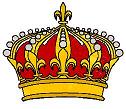
The kings of the other powers replace the fleur de lys by fleurons, and surmount the diadems of a sphere and a cross.
The coronet of England takes patty crosslets instead of fleurons, and is surmounted of a leopard.
The large-duke of Tuscany bore a coronet faceted on his circle of several bases, similar to those of the ancient coronets, but bent a little and surmounted, one on two, of fleur de lis couped. One added to it two large fleur de lys opened out of Florence.
The dolphins of France bore a crown only formed of four diadems. Each One of these diadems had the shape of a dolphin.
All the other children of France had only the circle Or surmounted of eight fleur de lys without diadem.
The other princes of blood had only four fleur de lys and four fleurons.
The princes of the Holy Roman Empire are used for themselves Ermine to stamp their coats of arms of a bonnet of scarlet raised, crowned of a half-circle Or adorned of pearls, and surmounted of a sphere, like that of the emperors.
The dukes, in France, bear their coronet, Or, raised of eight fleurons and enriched by precious stones and pearls.

That of the marquises is surmounted of four fleurons, separated each one by three pearls which one formerly set on an of the same line, but which is joined together today forms some of trefoil.
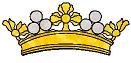
The coronet of the counts does not have of fleurons; it is raised of sixteen large pearls including nine visible, borne each one on a base. Some former heraldists wanted that this coronet was reserved for sovereign counts, and that for that of the nonsovereign counts the pearls were set immediately on the circle. This distinction was not followed.

The coronet of viscount is raised only of four pearls, including three visible.
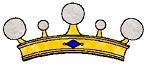
That of voided is surmounted of four cross formy, patty in base.
The barons have only one circle Or enamelled, accompanied of a bracelet or chaplet of pearls. This chaplet was often granted by the sovereigns like rewards honorary. Edouard, king d' Angleterre, gave some Eustache de Ribeaumont, his prisoner, and made him given of its ransom in honour of the bravery which it had deployed.
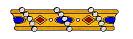
The knights bannerets stamped their shield of a circle Or adorned of pearls.
The wreath was only one roller of ribbon to colours of the shield, often of the same to colours that the lady of the knight affectionnait. One placed it on the helmet as simple ornament to which the indication of no title was attached.
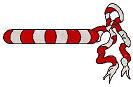
The chancellors or Ministers of Justice of France set on the helmet of which they stamp their shield a round mortar, of fabric Or, embroidered of the same and turned up Ermine.
The presidents with mortar of the courts of Parliament Or have a black mortar, raised of two broad stripes.
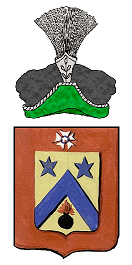
The emperor Napoleon had substituted for coronets of noble titrated
toques surmounted of feathers of which the number indicated dignity of
that which bore them. This use was not preserved, and the families
ennobled or titrated by Napoleon took again the old coronets. However,
as the monuments of time bear these badges, it is good of making known
them.
The princes high-ranking dignitaries had a toque of black velvet, surmounted Vair with door-egret Or surmounted of seven feathers.
The dukes were characterised only by the toque rolled up Ermine instead of Vair.
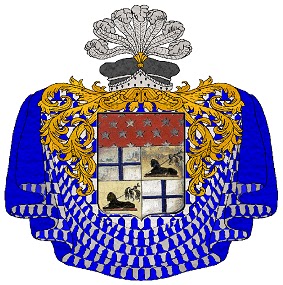
The counts had the toque of black velvet, turned up of Ermines, with door-egret out of Or and Argent surmounted of five feathers.
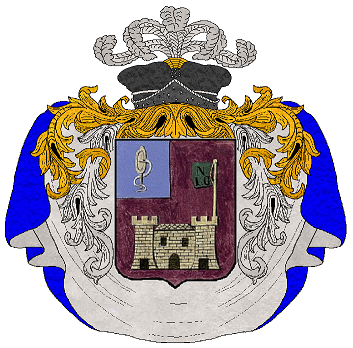
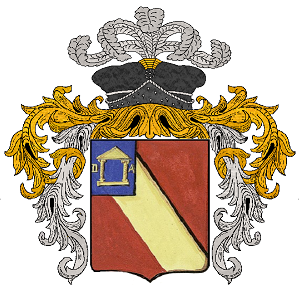
The barons rolled up the toque of counter-Vair; Argent door-egret, with three feathers.
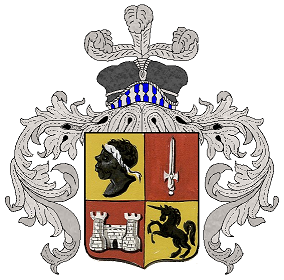
The knights bore the toque of black velvet turned up Vert, surmounted of a white egret or Argent.
The ecclesiastics have also an ornament indicating dignities of which
they are dressed. It is a hat surmounting the coronet and the
escutcheon.
The cardinals have the red hat on broad board, accompanied of let us string colour of the same interlaced and finished by five tassels.
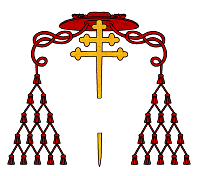
The archbishops take a hat on large board which entirely covers the shield like that of the cardinals. It remotely only by the green colour, and hanging, 4 tassels instead of five.
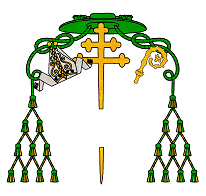
The hat of the bishops is also Vert and hanging, 3 the tassels.
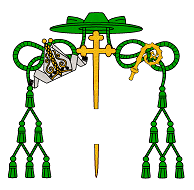
The abbots and protonotaires bear on the shield of their coats of arms a black hat of which string them interlaced and hanging end in two tassels colour of the same.
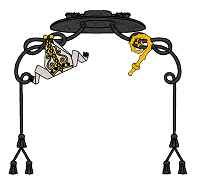
The priors and abbesses accompany their coats of arms of a chaplet or patenôtre.
The widows accompany their shield of cordelieres of silk black and
white interlaced. This habit is due to the queen Anne de Bretagne, who
adopted it after death of its first husband Charles VIII.
The daugthers, who, we have it already called, bear the lozenge shield and set it in a garland of flowers.
When the coats of arms are crested of a helm, one generally sees this
one adorned of named fabric pieces lambrequins. The origin of this
ornament is very old and comes from the hood which the knights usually
set on their helmet, to prevent that the heat of the sun did not
overheat steel, or of the same to preserve this one of the rust
produced by moisture. Sometimes it was a mantelet which, fixed at top
of the helmet, entirely wrapped it and covered also the shoulders;
other two hands clasped it was a simple mantelet or clothing of head
which one let fly to the liking of the wind and which became thus an
ornament of most gracious. Often a knight, to the return of a battle,
returned with his mantelet gashed of blows of sword, honour that each
one envied, since it proved that one had been a fort fray. Vanity did
not miss of seizing this mark bravery, and everyone wanted to adorn its
coats of arms of them. The use once general, the origin was forgotten
and these hieroglyphs of the honour underwent all the whims of
fashions; each one varied the form with its liking from it. The
lambrequins became today one of the most gracious ornaments of the
coats of arms by the odd or elegant forms that the painters and the
engravers give them.
In practise ordinary of the blazon, the lambrequins must be of the same tinctures as the field and the pieces of the shield. When the coats of arms have supporters, one represents the volant lambrequins to sides of the helmet without them wrapping the shield; one gives them today a form rather similar to that of the leaves of acanthus.
The wreath is a tower of liveries placed at top of the helm, and composed of the of the same tinctures as the lambrequins, to which it is used as fastener. Its goal was originally to deaden the blows dealt on the head.
Under the French empire, one added lambrequins to toques which replaced the coronets, and, by an error which it is impossible of being explained, one violated the rules of the blazon by composing them of metal on metal. The princes high-ranking dignitaries and the dukes bore six lambrequins Or; the counts adorned their toque of four lambrequins, the two superiors out of Or, and the two others Argent. Finally the barons had two lambrequins Argent.
Crests were thus called by the former heralds because they are set to
the crest or top of the helmets; they are the ornament as this helmet
is itself the ornament of the shield. Highest antiquity shows us the
warriors placing on their head of the fantastic objects to appear more
frightening to their enemies, or to give to eyes of their companions a
more majestic aspect. Jupiter Ammon was represented bearing a ram in
crest, Mars a lion, Bacchus a panther, Minerve an owl. Hercules had
adopted the head of the lion of Némée, and Aventinus, one of its
descendents, preserved the of the same crest. Alexandre le Grand, who
claimed himself resulting from Jupiter Ammon, bore also a lion; and
Pyrrhus, king of Epire, had adopted horn of goat. Diodore of Sicily
called that the kings of Egypt bore in crest of the heads of lion, bull
or wyvern.
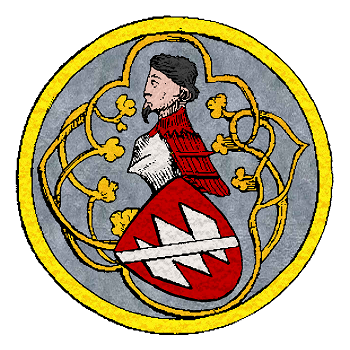
Example of a crest (human head)
Coats-of-arms of Guillaume d'Aubigné, 1367
The knights of the Middle Ages took care well not to give up an also widespread ancient use at all the nations, and the tournaments transfer all the valiant knights to adorn their helms of heraldic ornaments. The panaches, vol of 2 wings conjoined in bases of birds, the animals, the chimerical monsters, the mermaids, were employed in turn. Figure of the shield, such as the fleur de lys, still adorned the head of that which bore from there in its coats of arms. A kind of crest which one finds very widespread in Germany, and often in the former families of France, is that of horn. This use had come from antiquity, and horn them were looked like a mark of power. The dukes of Brittany adorned their helmet of it, like many of other sovereign princes. We have already called that the knights who had assisted, 2 tournaments adopted also this kind of crest.
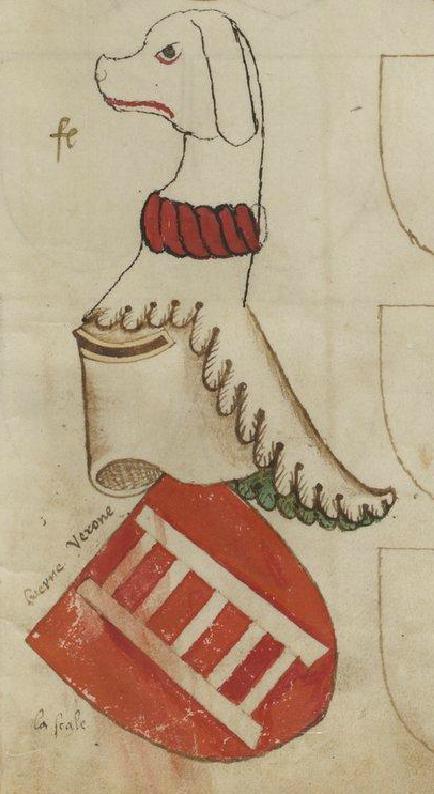
Example of an animal crest (dog's head) : Verone coats-of-arms
Source : Armorial de Bellenville, ms.fr. 5230, Bibliothèque Nationale de France (gallica.bnf.fr)
The crests were often mottos or marks of convention between a knight and his lady, to the means of which this one only could, in a tournament, to recognise the hero of which it inspired the prowesses. It was thus only one optional ornament which as many times as it could change liked the of the same individual, according to the circumstances, and that its descendents were entirely free to adopt or of rejecting.
The honourable pieces of the blazon are not set in crest.
The crests were done out of paperboard or boiled leather, which one recovered of painting and varnished making them impermeable. Those of iron or wood were rare, because their weight embarrassed the head of the knight.
When a family has a crest hereditarily, the branches juniors are satisfied with changing it to operate a cadency in the coats of arms.
Sources:
Complete Treaty of the Science of the Blazon, J. of Eschavannes - 1885
Nobility, blazon, order of knighthood: heraldic handbook, E. Dentu - 1859
Heraldic Treasury, A. of the Door - 1864
HELMET AND HELM
Before the coronets were of a use as widespread as they are it today to stamp the coats of arms, one made use only of the helmet or helm, and by means of fixed rules, the position and the title of each gentleman were recognised perfectly. Though these payments were not always followed exactly, it should not be believed that the use of the various species of crests is optional. Before the fifteenth century, the helm was set of profile, on the left base of the shield, and it was not whereas a simple ornament; but when the fashion came from setting the shield of face, the helmet, preserved like ornament, was still the distinctive mark of the position of the people, and the following rules were laid down.
The helmet of the kings and the emperors Or, is damascened, tared (set) in face, the visor entirely opened and without grid, because the sovereign must all see and all to know. The helmet thus tared is the mark of the absolute power, which turns up only of God alone.
The sovereign princes and dukes bear the helmet also Or, damascened and tared of face, but less open than that of the sovereigns, to indicate that they turn up of a higher power. They can add eleven grids to it.
Nonsovereign dukes; the marquises, the large officers of the coronet, such as the chancellors, the admirals, the marshals, stamp of a helm Argent damaged of face, with eleven grids, damascened and fimbriated Or.
The helmet of the counts, viscounts and voided, is Argent, damaged to the third, with nine grids Or, the edges of the same. One sees it sometimes damaged of face, but it is an exemption from principles which could not be devoted, of the same by the use.
The helmet of the barons, is Argent set of three quarters, on seven grids Or only, and the board of the same.
The old gentleman who was knight or whom the sovereign had dressed of some charges important in the armed ones or to the court, stamped his shield of a steel helmet polished, showing five grids Argent as well as the edges, and tared of profile.
The gentleman of three paternal and maternal races bore his steel helmet polished, tared of profile, the opened visor, the nasal one turned up and the abased ventail, showing three grids with his visor.
The new ennobled crest of a helmet of iron or steel polished, set of profile, whose nasal one and the ventail between is opened, which means that being the first of its race it does not have anything to see actions of others and must rather obey but to command.
The helm of bastard is also of steel polished and damaged of profile, but turned in sinister, like mark of illegitimacy, and the completely lowered visor.
Some authors give to dukes eleven grids, new marquis, counts and viscounts seven, barons five, and gentlemen three.
CROWNS
The first kings of France had as coronets only circles Or massive, set on the naked head or the helmet. It was Charlemagne which it first was covered with a genuine coronet adorned of fleurons and invaluable stones. Vulson called to have seen it preserved in the treasure of Saint-Denis and it gives of it a drawing which it ensures being exact fort, adding that this coronet was useful to the sacring of the kings.
All the noble ones titrated, in imitation of sovereigns, wanted to be vested of coronets, that they placed on the helms. The habit of always joining these two ornaments was abandoned and is to the practised nothing any more but in certain cases left besides imagination. One is satisfied almost generally today with surmounting the shield of a coronet.
On different occasions the sovereigns had to repress the usurpation of the coronets by people whom them title did not authorise to bear them. Thus counts took coronets of marquis or dukes, and of simple gentlemen wanted of the same to stamp their coats of arms of coronets belonging to higher titles. The stop of 1663 bearing tusk with any gentleman not titrated of taking the qualification of duke, marquis, count, etc…, under penalty of 1500 pounds of fine, put an end to the abuse during some time; but it was renewed soon, and one could believe today that there is no more of laid down rules, so much the usurpations of this kind were numerous. Let Us Hope that in the absence of legislative provisions, the public sarcastic remarks will make justice of these usurpations that one could not fade too much. (I often saw families taking a title in which they believed in good faith to have permissions, because they had a seal of family, crested of a coronet. One must look like a duty of lighting them in this respect, and of their making reject any claim based on an also futile and so contestable document).
The coronet of the popes or tiara is composed of a toque Or, adorned at its top of a surmounted sphere of a cross. It is accompanied of triple crowns Or, and lets hang two string semy of crosslets. The three coronets represent the pope like the sovereign sacrificator, the large judge, and the only legislator of the Christians. Spiritual Sovereign of all the catholic people, representing of God on the ground, the pope is regarded as the highest power which, after God, extends on humanity. The tiara is also called Regnum.
The coronet of the emperors pointed and is raised of way of mitre, having in the middle of two bases a surmounted diadem of a round ball and a cross of pearls. The emperors of Germany received this coronet of the hands of the pope, to indicate that they were emperors of Christian mound. The emperor Napoleon had taken a closed coronet whose circles were supported alternatively by a fleuron and an eagle.
The crown of France was made of a circle surmounted of eight fleur de lys, to the nourished foot, serving as bases with beaded diadems which meet in top by a fleur de lys doubles.
The kings of the other powers replace the fleur de lys by fleurons, and surmount the diadems of a sphere and a cross.
The coronet of England takes patty crosslets instead of fleurons, and is surmounted of a leopard.
The large-duke of Tuscany bore a coronet faceted on his circle of several bases, similar to those of the ancient coronets, but bent a little and surmounted, one on two, of fleur de lis couped. One added to it two large fleur de lys opened out of Florence.
The dolphins of France bore a crown only formed of four diadems. Each One of these diadems had the shape of a dolphin.
All the other children of France had only the circle Or surmounted of eight fleur de lys without diadem.
The other princes of blood had only four fleur de lys and four fleurons.
The princes of the Holy Roman Empire are used for themselves Ermine to stamp their coats of arms of a bonnet of scarlet raised, crowned of a half-circle Or adorned of pearls, and surmounted of a sphere, like that of the emperors.
The dukes, in France, bear their coronet, Or, raised of eight fleurons and enriched by precious stones and pearls.
That of the marquises is surmounted of four fleurons, separated each one by three pearls which one formerly set on an of the same line, but which is joined together today forms some of trefoil.
The coronet of the counts does not have of fleurons; it is raised of sixteen large pearls including nine visible, borne each one on a base. Some former heraldists wanted that this coronet was reserved for sovereign counts, and that for that of the nonsovereign counts the pearls were set immediately on the circle. This distinction was not followed.
The coronet of viscount is raised only of four pearls, including three visible.
That of voided is surmounted of four cross formy, patty in base.
The barons have only one circle Or enamelled, accompanied of a bracelet or chaplet of pearls. This chaplet was often granted by the sovereigns like rewards honorary. Edouard, king d' Angleterre, gave some Eustache de Ribeaumont, his prisoner, and made him given of its ransom in honour of the bravery which it had deployed.
The knights bannerets stamped their shield of a circle Or adorned of pearls.
The wreath was only one roller of ribbon to colours of the shield, often of the same to colours that the lady of the knight affectionnait. One placed it on the helmet as simple ornament to which the indication of no title was attached.
The chancellors or Ministers of Justice of France set on the helmet of which they stamp their shield a round mortar, of fabric Or, embroidered of the same and turned up Ermine.
The presidents with mortar of the courts of Parliament Or have a black mortar, raised of two broad stripes.
ORNAMENT OF THE FRENCH FIRST EMPIRE
The princes high-ranking dignitaries had a toque of black velvet, surmounted Vair with door-egret Or surmounted of seven feathers.
The dukes were characterised only by the toque rolled up Ermine instead of Vair.
The counts had the toque of black velvet, turned up of Ermines, with door-egret out of Or and Argent surmounted of five feathers.
The barons rolled up the toque of counter-Vair; Argent door-egret, with three feathers.
The knights bore the toque of black velvet turned up Vert, surmounted of a white egret or Argent.
ORNAMENT OF THE ECCLESIASTICS
The cardinals have the red hat on broad board, accompanied of let us string colour of the same interlaced and finished by five tassels.
The archbishops take a hat on large board which entirely covers the shield like that of the cardinals. It remotely only by the green colour, and hanging, 4 tassels instead of five.
The hat of the bishops is also Vert and hanging, 3 the tassels.
The abbots and protonotaires bear on the shield of their coats of arms a black hat of which string them interlaced and hanging end in two tassels colour of the same.
The priors and abbesses accompany their coats of arms of a chaplet or patenôtre.
ORNAMENT OF THE MAIDENS
The daugthers, who, we have it already called, bear the lozenge shield and set it in a garland of flowers.
LAMBREQUINS
In practise ordinary of the blazon, the lambrequins must be of the same tinctures as the field and the pieces of the shield. When the coats of arms have supporters, one represents the volant lambrequins to sides of the helmet without them wrapping the shield; one gives them today a form rather similar to that of the leaves of acanthus.
The wreath is a tower of liveries placed at top of the helm, and composed of the of the same tinctures as the lambrequins, to which it is used as fastener. Its goal was originally to deaden the blows dealt on the head.
Under the French empire, one added lambrequins to toques which replaced the coronets, and, by an error which it is impossible of being explained, one violated the rules of the blazon by composing them of metal on metal. The princes high-ranking dignitaries and the dukes bore six lambrequins Or; the counts adorned their toque of four lambrequins, the two superiors out of Or, and the two others Argent. Finally the barons had two lambrequins Argent.
CRESTS
Example of a crest (human head)
Coats-of-arms of Guillaume d'Aubigné, 1367
The knights of the Middle Ages took care well not to give up an also widespread ancient use at all the nations, and the tournaments transfer all the valiant knights to adorn their helms of heraldic ornaments. The panaches, vol of 2 wings conjoined in bases of birds, the animals, the chimerical monsters, the mermaids, were employed in turn. Figure of the shield, such as the fleur de lys, still adorned the head of that which bore from there in its coats of arms. A kind of crest which one finds very widespread in Germany, and often in the former families of France, is that of horn. This use had come from antiquity, and horn them were looked like a mark of power. The dukes of Brittany adorned their helmet of it, like many of other sovereign princes. We have already called that the knights who had assisted, 2 tournaments adopted also this kind of crest.
Example of an animal crest (dog's head) : Verone coats-of-arms
Source : Armorial de Bellenville, ms.fr. 5230, Bibliothèque Nationale de France (gallica.bnf.fr)
The crests were often mottos or marks of convention between a knight and his lady, to the means of which this one only could, in a tournament, to recognise the hero of which it inspired the prowesses. It was thus only one optional ornament which as many times as it could change liked the of the same individual, according to the circumstances, and that its descendents were entirely free to adopt or of rejecting.
The honourable pieces of the blazon are not set in crest.
The crests were done out of paperboard or boiled leather, which one recovered of painting and varnished making them impermeable. Those of iron or wood were rare, because their weight embarrassed the head of the knight.
When a family has a crest hereditarily, the branches juniors are satisfied with changing it to operate a cadency in the coats of arms.
Sources:
Complete Treaty of the Science of the Blazon, J. of Eschavannes - 1885
Nobility, blazon, order of knighthood: heraldic handbook, E. Dentu - 1859
Heraldic Treasury, A. of the Door - 1864

Custom Search